By
By 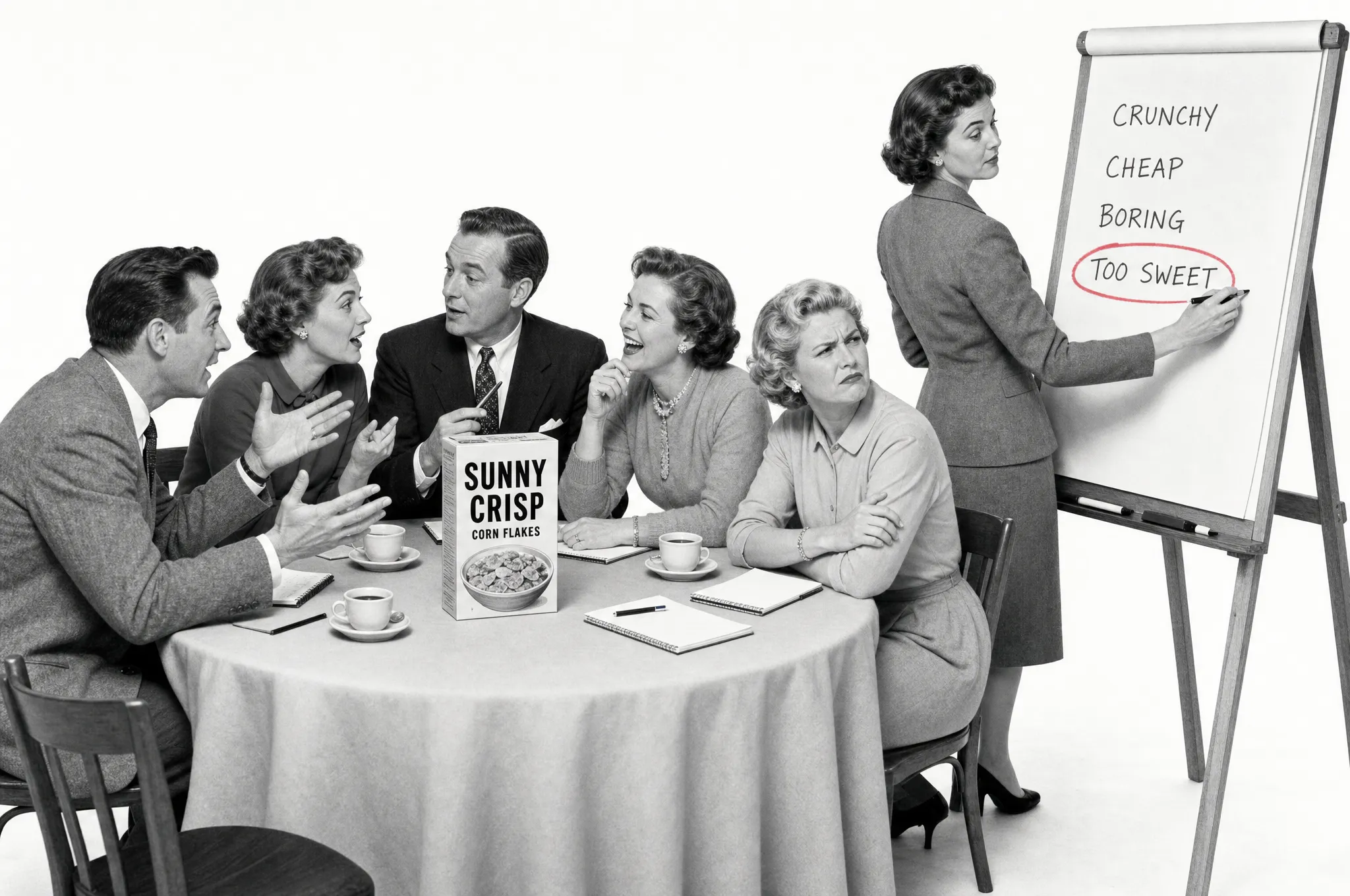
A focus group is a moderated group discussion: six to nine people, ninety minutes or so, run to hear how people think and talk about an idea. That part is easy. The useful part is knowing when one is worth five figures of your budget and when something faster gets you the same answer.
In 1941 Robert K. Merton sat people down to react to wartime radio broadcasts, and the method he wrote up is still recognisable in every focus group run today. It was built to explore how people respond to ideas. It was never built to predict what they would buy. Almost everything that goes wrong with focus groups traces back to that one distinction, so what follows is how a group actually runs, what it costs in 2026, the questions that make or break it, and the faster methods that now do most of its old job.
What a focus group actually is
A focus group is a moderated group discussion used in qualitative research. A trained moderator brings together a small group of people, works through a planned set of topics, and listens to how they talk about a product, service or idea. The Nielsen Norman Group puts the classic shape at 6 to 9 users for about two hours, run by a moderator who keeps the group focused.
The word doing the work is “focus”. It refers to the moderator’s job, which is to keep a free-flowing conversation pointed at the questions that matter without steering the answers. To the participants it should feel loose and unstructured. In reality the moderator is following a script and hitting a set of goals for what needs to come out of the session.
The point is qualitative. You are not counting anything. You are listening for reasoning, reactions and the exact words people reach for when nobody has handed them a script. Done well, a focus group tells you what people want and why, and hands you the language to use in your own copy. That is the job it is built for. Most of the trouble with focus groups comes from asking them to do a different job, which we will get to.
Where focus groups came from
Focus groups are older than most people assume, and the origin story is worth knowing because it explains what they are good at. In 1941 the sociologist Robert K. Merton, working with Paul Lazarsfeld at Columbia’s Office of Radio Research, sat groups of people down to react to wartime radio broadcasts and government morale films. Instead of a survey, they let people respond in their own words and probed the reasoning behind the reactions.
Merton and his colleagues Marjorie Fiske and Patricia Kendall wrote the method up in The Focused Interview in 1956, and the procedures they set down are still recognisable in any focus group today. Marketing picked the method up in the decades after, and it became the default way to test adverts, packaging and product concepts. The lineage matters: focus groups were built to explore how people respond to messages and ideas, not to measure how they behave. That distinction is the whole game.
How a focus group runs, start to finish
Strip away the variations and every properly run focus group moves through the same stages.
You start with recruitment and screening. A recruiter finds people who match a defined profile, your target customer, a specific demographic, users of a competing product, and screens out anyone who does not fit or who does this for a living. This is the step brands most often cut corners on, and it is the one that quietly ruins results. A group of the wrong people gives you confident answers to the wrong question.
Then the moderator writes a discussion guide. This is the two-to-three-page script of topics, timings and probes that the session will follow. It looks casual from the inside and is anything but.
The session itself runs 90 minutes to two hours. The moderator opens with easy warm-up questions to get everyone talking, moves through the topic, and does the hard work of keeping the discussion on track while making sure the loudest person in the room does not become the only voice. Stakeholders often watch from behind a one-way mirror or, increasingly, over a video link.
Afterwards comes analysis. At its simplest this is the moderator writing up the prevailing mood with a few sharp quotes. Done properly it means working back through the transcript for patterns, tensions and the language worth stealing. Because the data is unstructured, this stage is slower and more subjective than people expect.
Most studies do not stop at one group. The Nielsen Norman Group advises running more than one, because the outcome of any single session can be an accident of who happened to be in the room.
What a focus group costs in 2026
This is the number the definition pages never give you. A standard focus group project typically runs $10,000 to $30,000, according to Drive Research, with online formats coming in cheaper because they remove facility hire, travel and catering.
That figure covers recruitment, a professional moderator, the venue or platform, and analysis, usually across more than one group. On top sit participant incentives, which Drive Research puts at $75 to $150 for members of the general public and from $100 up past $500 for harder-to-reach business professionals giving 90 minutes of their time. Because a single group is rarely enough to trust, a real project almost always means two, three or four groups, and the budget scales with them.
One thing to hold steady when you compare quotes: that range is per project, covering more than one group. Agencies often quote per group instead, and Drive Research’s wider pricing work puts a single group at 7,000 to 20,000 dollars or more. The two figures are not in conflict, they are different units, but they are easy to mistake for one another when a number lands in your inbox. Ask which you are being quoted. Our guide to online focus groups breaks the per-group costs down line by line, and online formats sit at the lower end of both ranges.
None of this makes focus groups a bad buy. It makes them a considered buy. At five figures a project, a focus group is worth it when the question genuinely needs a room full of people talking, and hard to justify when a cheaper method would answer it just as well. Knowing which is which is the point of the rest of this piece.
If five figures is not your budget
There is a middle option between hiring an agency and giving up. You can run a serviceable group yourself: six customers on a video call, ninety minutes, a written discussion guide, a colleague taking notes so you are not moderating and recording at the same time, and a gift card each.
Be honest about what you lose. There is no professional moderator keeping the loudest person in check, your screening will be softer than a recruiter’s, and a group pulled from your own customer list leans positive before anyone speaks. What you keep is the thing groups are genuinely best at: the words people use and the reasoning underneath them. For discovery that is often enough. For anything you intend to defend to a board or an investor, pay for the real thing.
The questions that make or break a focus group
If you take one practical thing from here, take this. A focus group is only as good as its questions, and good questions follow a shape. The framework that most moderators use, set out in Richard Krueger’s work and summarised in the NIH’s Spotlight on focus groups, sorts questions into five types that you move through in order.
Opening questions are easy, factual and answered fast, round the table, to get every voice in the room. “Tell us your name and what you had for breakfast.” Nobody is being profound; you are just breaking the ice so people are used to speaking.
Introductory questions put the topic on the table without diving in. “When you think about buying running shoes, what comes to mind first?” You are getting people oriented and surfacing their starting assumptions.
Transition questions move the group toward the core. “Walk me through the last time you bought a pair.” Now you are into real behaviour and specifics.
Key questions carry the study. These are the two to five questions the whole session exists to answer, and you give them the most time. “What would make you switch from the brand you buy now?” “What almost stopped you buying these?” This is where the budget earns out.
Ending questions bring closure and check you heard right. The classic is the all-things-considered question: “Of everything we discussed, what matters most to you?” Followed by a summary the group can correct.
Two rules sit underneath all of it. Ask about behaviour before attitude, because what people did is firmer ground than what they think they think. And ask unaided before aided: let people tell you what comes to mind before you show them your options, or you will only hear your own ideas read back to you. Keep every question open-ended. The moment a question can be answered “yes” or “no”, it stops being a focus group question.
The one thing focus groups are bad at
Here is the limit that matters, and it is baked into the method rather than a sign of a bad moderator. A focus group can only tell you what people say they do. It cannot tell you what they actually do. Jakob Nielsen has made this point for decades: because there are real differences between what people say and how they behave, direct observation still has to sit alongside a focus group, never replace it.
That gap gets wider in a group, for three well-documented reasons.
Social desirability bias means people give the answer that makes them look good rather than the true one. They overstate how healthy, how frugal or how environmentally minded they are, because a table of strangers is watching.
Groupthink means people drift toward the emerging consensus. Once two confident participants agree, the quieter dissent in the room tends to stay quiet, and you lose exactly the minority view you might most need to hear.
Moderator effects mean the person running the room shapes the answers, through a leading question, a raised eyebrow or a nod at the wrong moment. Skilled moderators minimise this; none of them eliminate it.
While we are here, it is worth killing the story everyone reaches for. New Coke is routinely held up as the disaster focus groups caused, and it is the wrong lesson. The bulk of that research was blind taste testing rather than group discussion, and roughly 200,000 people took part. The tests were not even wrong: people did prefer the sweeter formula in a sip. What nobody measured was attachment, how drinkers would feel about the original being taken away from them, which is not a question a sip test can ask. The failure was reaching for an instrument that answered preference when the decision turned on loyalty. That is the same category of mistake as asking a focus group to predict a purchase, which is why the story is worth getting right rather than repeating.
Add the small sample, 6 to 9 people times a couple of groups, and the honest conclusion is this: a focus group produces rich hypotheses and quotable language, not a forecast. Treat the output as things to go and check, not as a verdict. Use it to decide what to build and how to talk about it, then validate the actual decision, will people buy this, with a method built for prediction. This is exactly the mistake Merton’s method was never meant to make, and the reason the field has spent the last few years building faster ways to answer the buying question.
What’s replacing focus groups
Nothing has replaced the focus group outright. What has happened is that its workload has spread across a set of methods that are cheaper, faster, or better at the prediction part. Here is the map, and our wider guide to market research methods has the full set.
One-to-one interviews trade breadth for depth. You speak to people individually, so there is no group to conform to, and you can go deeper on personal reasoning. They are the natural choice for sensitive topics and for anything where you do not want the loudest voice setting the tone. The trade is time: interviews are slower to run and analyse per head.
Online focus groups keep the group format but move it to video or a text platform, which cuts the facility and travel cost and lets you recruit across the country instead of one city. You keep the group dynamics, good and bad, at a lower price. Our guide to online focus groups covers the formats and the per-group costs in detail.
AI-moderated interviews use software to run and analyse conversations with real people at a scale a human moderator cannot match. You get real human responses, faster and cheaper, though you lose some of the improvisational skill of a great moderator reading the room. We cover the two very different things people mean by “AI focus group”, one that moderates real people and one that invents them, in our guide to AI focus groups.
Scaled surveys give you a representative read from hundreds or thousands of people. They answer “how many” where a focus group answers “why”, and the two pair well: use a group to find the language, then a survey to size it.
Pre-spend concept testing is the newest piece, and it targets the exact weakness above: prediction. Instead of asking a room what they think of an idea, you put a product, ad, price, pack, claim or name in front of shoppers and get a purchase-intent signal back before you commit budget. It answers the buying question a focus group was never built to answer. If you want to go deeper on running a test properly, our piece on audience testing methods and tools walks through it.
This is the lane TestFeed sits in. You test a product, pack, ad, price, claim, concept, name or promo before spending on it, and you get back a purchase-intent score, the shoppers’ reasons in their own words and a clear next move, in days rather than the weeks a focus group project takes. It is directional, pre-spend signal, not a market forecast or a guaranteed sales number, and it does not judge taste, texture or smell. Used the right way, it does the prediction job a focus group cannot, and you can still run a group when what you need is the open-ended, exploratory conversation groups are genuinely best at.
So, should you run a focus group?
Use this to decide quickly.
| Your question | Best method |
|---|---|
| How do people talk about this category, and why? | Focus group |
| What language should our copy use? | Focus group or interviews |
| I need depth on a sensitive topic | One-to-one interviews |
| How many people feel this way? | Scaled survey |
| Will people actually buy this product, ad or price? | Pre-spend concept testing |
| I need real human conversation, fast and cheap | AI-moderated interviews |
| Same as a focus group, lower cost, wider reach | Online focus group |
The one-line version: run a focus group when you need to understand what people want and how they say it, and reach for a prediction method when you need to know whether they will actually buy. Focus groups are a discovery tool wearing a validation costume. Use them for discovery, be honest about the rest, and pick the cheaper, faster method whenever your question is really about behaviour.
Frequently asked questions
What is a focus group?
A focus group is a moderated group discussion used in qualitative research. A trained moderator guides a small group, usually 6 to 9 people, through a set of topics for around 90 minutes to two hours to understand how they think and feel about a product, service or idea. The goal is to hear reasoning and language, not to count anything or predict behaviour.
How many people are in a focus group?
Most focus groups run with 6 to 9 participants, which is large enough for a flowing discussion and a range of views without becoming a crowd where quieter people never speak. The Nielsen Norman Group recommends at least 6 and usually running more than one group, because a single session may not be representative.
How much does a focus group cost in 2026?
A standard focus group project typically runs $10,000 to $30,000, according to Drive Research, with online formats cheaper because they remove facility hire, travel and catering. Participant incentives run $75 to $150 for the general public and from $100 up past $500 for business professionals, and most projects need more than one group, so the budget scales.
What questions do you ask in a focus group?
Good focus group questions are open-ended and move through five stages: opening questions that get everyone talking, introductory questions that raise the topic, transition questions that move toward the core, key questions that carry most of the study, and ending questions that close and confirm. Ask about behaviour before attitude, and unaided before aided, so you hear what comes to mind before you prompt it.
What is replacing focus groups?
Nothing has replaced them outright, but the workload has spread across faster methods: one-to-one interviews for depth without group conformity, AI-moderated interviews for scale, scaled surveys for a representative read, and pre-spend concept testing when you need a purchase-intent signal on a product, ad, price or pack before you commit budget. Match the method to the decision rather than defaulting to a group.