By
By 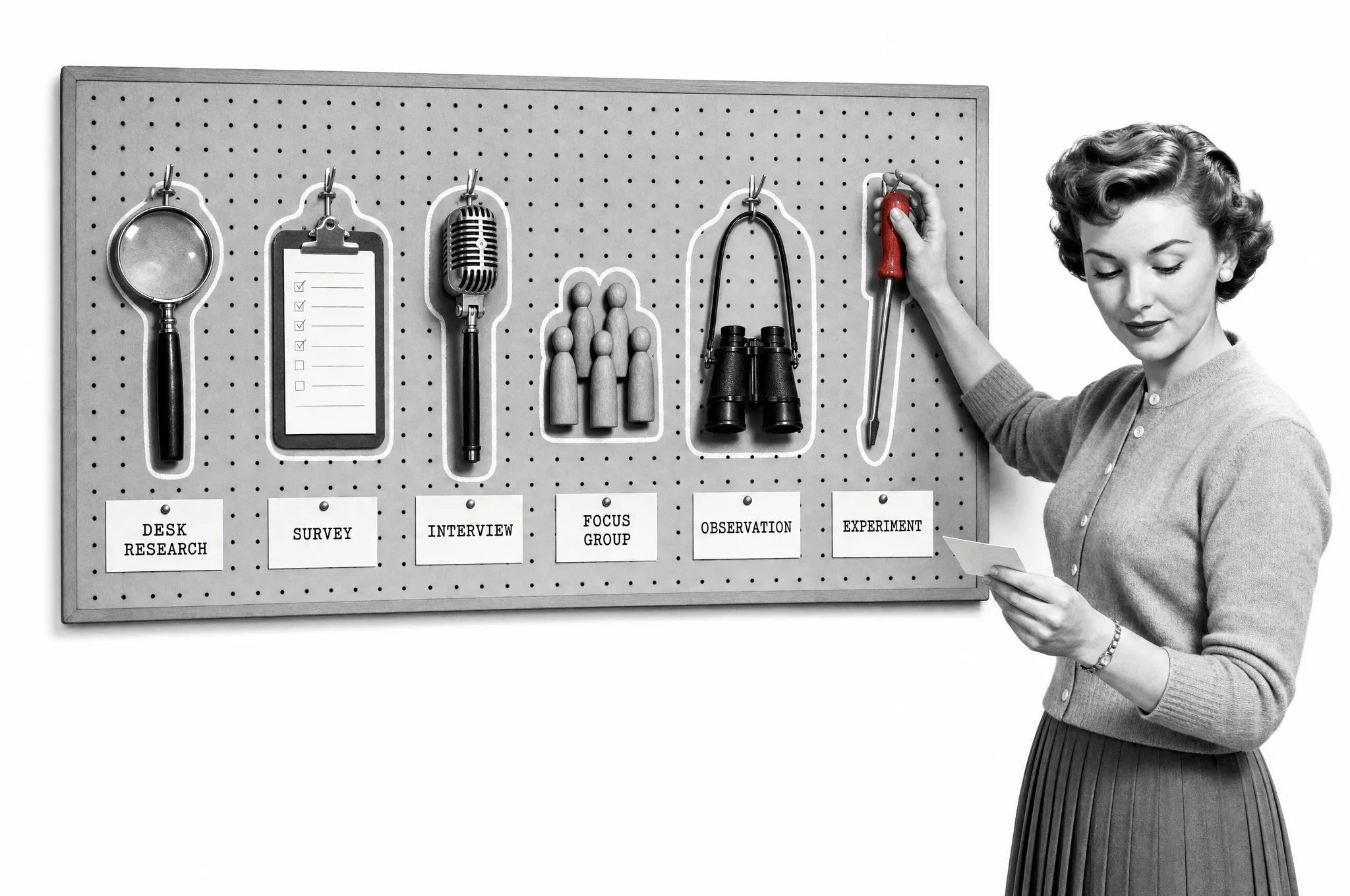
The methods themselves are not complicated. Picking the wrong one for the question is where the money and the weeks disappear, and that is the part most guides skip: they define the techniques and leave you to work out which one answers the decision sitting on your desk right now.
So this guide is organised around decisions, not definitions. You will get the full set of market research methods, what each one is genuinely good at, what it costs in money and time, and the exact way it will mislead you if you use it in the wrong place. There is a decision table you can use this afternoon, and a worked example of a product launch run end to end. Costs below are in pounds, and they are rough: what you pay depends far more on sample size and whether you run it yourself than on the method name.
The two questions that decide your method
Before you choose a method, answer two questions. They do more work than any list of techniques.
The first is: do you need primary or secondary data? Primary research is data you collect yourself, for your specific question. Secondary research uses data someone else already gathered, such as government statistics, industry reports, or a competitor’s published filings. Secondary is cheaper and faster and should almost always come first, because there is no sense paying to discover something that is already sitting in a public report. Primary is where you go when the answer you need does not exist yet, or when it is specific to your brand.
The second is: do you need qualitative or quantitative data? Qualitative research gives you words and reasons from a small number of people. It tells you why. Quantitative research gives you numbers from a larger sample. It tells you how many and how much. The mistake I see most often is teams reaching for a number when they do not yet understand the behaviour, or running a rich qualitative session and then treating six people’s opinions as if they represent the market.
Put those two axes together and you have a simple map. Most market research methods are just a point on it.
| Qualitative (why) | Quantitative (how many) | |
|---|---|---|
| Primary (you collect it) | Interviews, focus groups, ethnography, open-ended surveys | Surveys, choice experiments, A/B and in-market tests |
| Secondary (already exists) | Analyst commentary, published case studies, forum threads | Industry reports, census data, competitor sales filings |
Everything below fits somewhere on that grid. When you are unsure which method to run, do not start with the method. Start by placing your question on the map.
The methods, and the decision each one is actually for
Here is the working set. For each, what it answers, roughly what it costs in money and time, and the specific way it lies to you. If you want the tools that run each of these rather than the methods themselves, that is a separate shortlist.
Secondary, or desk, research. Reading what already exists: market sizing reports, trade-body data, census figures, competitor accounts, review sites. It answers “how big is this market and who is already in it” for close to nothing but your time. Start here every time. The trap is age and agenda. A report can be three years stale, and a vendor’s own white paper is marketing, not evidence. Check the date and check who paid for it.
Surveys. The workhorse of quantitative primary research, and the reason “how to do market research” so often just means “write a survey”. Good for sizing attitudes, measuring satisfaction, and comparing options across a real sample, and worth pairing with a few open-ended questions where you need the reason behind a number. Cost runs from nothing on a free tool to a few hundred pounds once you buy panel responses, and you can field one in days. The lie is twofold. People answer the question you wrote, not the one you meant, so a leading or vague question quietly manufactures the result. And self-report has a ceiling, which I come back to below. Sample matters as much as wording: a thousand responses from the wrong people is worse than a hundred from the right ones.
In-depth interviews. One person, one conversation, thirty to sixty minutes. This is the best method for understanding a decision in the customer’s own language: why they switched, what nearly stopped them, the words they use that you would never write yourself. Reckon on five to twelve interviews to see patterns. The cost is mostly your time plus a small incentive. The risk is that you hear a vivid story and mistake it for a common one. Interviews find the hypothesis. They do not size it.
Focus groups. Six to ten people in a room, or on a call, guided by a moderator, whether that is a traditional venue or one of the online focus group formats that have largely replaced it. Useful for watching people react to something in front of them and bounce off each other, which surfaces language and objections quickly. The honest problems are well documented. The loudest person sets the tone, quieter people converge on the group view, and everyone performs a little because they are being watched. Groups are good for generating ideas and reactions. They are poor for deciding anything, because you cannot count a room of eight.
Observation and ethnography. Watching what people actually do, in a shop, on a site, in their kitchen. This is the antidote to self-report, because you are recording behaviour rather than a description of behaviour. It is time-intensive and hard to scale, and observation changes what people do when they know they are watched. But for questions about how a product is really used, nothing beats seeing it.
Behavioural experiments. A/B tests, in-market tests, price and offer tests, live pilots. Instead of asking, you change one thing and measure what people do. This is the strongest evidence you can get short of a full launch, because it is behaviour with money attached. The constraint is traffic and time: a valid test needs enough visitors or buyers to reach significance, which is why small stores often do not have the traffic to A/B test anything but their highest-traffic page. Where you have the volume, trust an experiment over a survey every time.
Choice-based and pricing methods. When the decision is about what to charge or which features matter most, generic surveys fall apart, because “would you pay more” is a question people cannot answer honestly. Structured methods do better by making people trade off. Conjoint and MaxDiff force ranking under constraint. Pricing-specific techniques such as Gabor-Granger and the Van Westendorp price sensitivity meter map willingness to pay across a range. These hold up better than a flat “what would you pay”, though they still measure stated intent, not a till receipt.
Social listening and search data. Mining what people already say and search for, unprompted, across social platforms, forums and search engines. It is fast, cheap and free of the observer effect, because nobody is answering your survey. The weakness is that vocal minorities are loud and the silent majority is invisible, so listening tells you what is being talked about, not what is representative.
Sales and CRM data. Your own behavioural gold: what sells, to whom, how often, what gets returned. Most brands sit on more first-party data than they use. It is honest because it is what actually happened. Its limit is that it only describes people who already bought from you, so it says nothing about the market you have not reached yet.
A last category deserves its own honesty, and it gets a section later: AI and synthetic methods, where you model a likely response rather than field one. Handled well, it is a fast pre-spend signal. Handled badly, it is a confident guess wearing a lab coat.
Which method for which question
Find your decision on the left, and start with the method next to it. The cost column is the first pass only, because that is the bit you have to budget before you know whether you need the second.
| Your decision | Start with | Rough cost and speed | Then confirm with |
|---|---|---|---|
| How big is this market, who competes | Secondary research | Free, an afternoon | A targeted survey |
| Why do customers churn or switch | In-depth interviews | Incentives only, 1 to 2 weeks | A quantitative survey to size it |
| Which of three concepts to build | Concept test on a real audience | Low hundreds, days | A behavioural or in-market test |
| What to charge | Van Westendorp or Gabor-Granger | Panel fees, about a week | A live price test where traffic allows |
| Which ad or claim wins | Ad or message test | Low hundreds, days | In-market spend on the survivors |
| How satisfied customers are | Post-purchase or CSAT survey | Tool cost, ongoing | Interviews on the low scorers |
| How a product is really used | Observation or ethnography | Your time, 1 to 2 weeks | Usage data from your own analytics |
| Whether demand exists at all | Search and social listening | Free to low, days | A pre-launch demand test |
The pattern running through it: qualitative or desk work to find and frame the question, then a quantitative or behavioural method to size and confirm the answer. One method rarely finishes the job. The skill is sequencing them so you spend the least to get to a confident call.
On sample size, the honest answer is that it depends on how big a difference you need to detect, and anyone who gives you a single number is guessing. As working rules: five to twelve interviews before the same themes start repeating, a few hundred survey responses to compare two or three options with any confidence, and more than a thousand if you want to slice results by segment. Below about a hundred you are reading noise, however neat the percentages look.
The say-do gap, and why it matters more than method choice
Here is the uncomfortable part that most market research methods share. When you ask people what they will do, they tell you what they think they will do, or what makes them look good, and that is a weak predictor of what they actually do.
This is measured, not folklore, and the numbers are worth carrying around. Webb and Sheeran’s meta-analysis of 47 experimental tests, published in Psychological Bulletin, found that a medium-to-large change in people’s intentions, an effect size of d = 0.66, produced only a small-to-medium change in their behaviour, d = 0.36. Intentions move a lot; behaviour moves about half as much. Psychologists call it the intention-behaviour gap, and operators know it as the say-do gap. It is why “yes I would definitely buy that” so often ends in an empty cart.
You cannot delete the gap, but you can design around it. Three practical moves. First, prefer behaviour over statement wherever you can afford it, which means an experiment or a live test beats a survey when the stakes are high. Second, when you must ask, ask about the concrete and the recent rather than the hypothetical and the future, because “what did you buy last time” is more reliable than “what would you buy”. Third, frame around purchase intent and trade-offs rather than open enthusiasm, because forcing a choice under a constraint reveals more than inviting an opinion.
The trap is treating any stated-preference method as a forecast. It is directional signal. Good research lowers the risk of a decision. It does not remove it, and any method that promises certainty is selling something.
A worked example: launching a new product
Abstract methods are easy to nod along to and hard to apply, so here is one decision run through the whole framework. Say you are a food and drink brand weighing up a new flavour and a new pack size.
You start with secondary research, because it is free. Category reports and retailer data tell you the flavour trend is real and growing, and that the pack size you are considering sits in a gap on the shelf. That took an afternoon and told you the idea is not mad.
You move to a handful of interviews with existing customers. Five conversations surface the actual reason people buy you, and one recurring worry about the new flavour that you had not considered. Now you have a sharper hypothesis and better survey questions than you would have written cold.
You field a survey to a proper sample to size what the interviews suggested. You learn the flavour splits opinion and the pack size is broadly welcome. Useful, but remember the say-do gap: a survey that says people like it is not the same as people buying it. For anything involving what they will actually pick up and pay for, you want concept testing against a representative audience, and ideally a behavioural or in-market signal before you commit to a production run.
Only then do you decide. Notice the sequence: cheapest and fastest methods first, each one narrowing what the next has to test, behaviour brought in before the expensive, irreversible commitment. That ordering is most of the craft. For anything you cannot test in taste, texture or smell, no method substitutes for a physical sample in a real mouth, and it is worth being honest about that limit up front.
How to run any study in five steps
Whatever methods you pick, the process is the same. This is the whole of “how to do market research”, stripped to what matters.
Start by writing the decision, not the topic. “We are deciding whether to launch flavour A or B into which pack size” is a decision. “Learn about our customers” is a way to spend three weeks and conclude nothing. If you cannot name the choice the research will inform, stop and name it first.
Then choose the method from the decision, using the table above. Match the technique to the question and the resources you actually have, not to the method you find most comfortable.
Then design the sample and the instrument together. Who you ask matters as much as what you ask, and a small representative sample beats a large biased one. This is also where survey wording earns or wastes the whole budget, so pilot your questions on a few people and cut anything that leads the answer.
Then collect the data cleanly, watching for the failure modes of your chosen method: low response, a dominant voice in the room, the observer effect. And finally, analyse and decide. The point of the last step is a decision, not a deck. If the research does not change what you do, you either asked the wrong question or you were never going to act on the answer.
Where AI and synthetic methods fit, honestly
The newest entry in the market research methods toolkit is AI: synthetic respondents, AI focus groups, models that predict a likely reaction instead of fielding a live one. There is real hype here, and it deserves a clear-eyed take rather than a sales pitch.
What these methods are genuinely good at is speed and cost at the pre-spend stage. When you have a product, a pack, an ad, a claim, a price, a concept, a name or a promo and you want a directional read before you commit budget, modelling a likely response can hand you a signal in days rather than the weeks a traditional study takes. That is a real change to how early you can get feedback, and how many ideas you can afford to check.
What they are not is a market forecast or a guarantee. They give you directional signal, not a promised sales number, and they say nothing about taste, texture or smell. Treated as a fast first filter that tells you which ideas are worth the expensive, slower validation, they earn their place. Treated as the final word, they will burn you the first time a confident output turns out to be wrong.
This is the honest niche a tool like TestFeed fills. You put an idea in front of your target shopper before spending on it, and you get back a purchase-intent read, a verdict, the reasons in shoppers’ own words, and a clear next move, fast enough to test several ideas in the time one focus group would take to schedule. It is a pre-launch signal that lowers the risk of what you commit to. It does not replace a live in-market test on the decisions that carry the most money, and it is better for it that it does not pretend to.
Common mistakes that waste the whole budget
A few failure patterns show up again and again, across every method.
Running research you will not act on. If the decision is already made, you are not researching, you are looking for permission, and it is cheaper to just decide.
Asking the wrong people. A representative sample of your actual buyers beats a big sample of anyone. Convenience samples, your own newsletter list, your Twitter followers, quietly bias everything downstream.
Leading the witness. A question that hints at the answer you want gets you that answer. Neutral wording is not pedantry, it is the difference between data and a mirror.
Confusing qualitative and quantitative. Eight people in a focus group cannot tell you what percentage of the market agrees, and a survey cannot tell you the messy human reason behind a number. Use each for what it does.
Trusting statement over behaviour on high-stakes calls. The say-do gap is real and measured. When the decision is expensive or irreversible, find a way to watch what people do, not just record what they say.
Frequently asked questions
What are the main market research methods?
The main methods are secondary (desk) research, surveys, in-depth interviews, focus groups, observation and ethnography, behavioural experiments such as A/B and in-market tests, choice-based pricing methods like conjoint and Van Westendorp, and social listening. They divide into primary versus secondary data, and qualitative versus quantitative approaches.
What is the difference between primary and secondary research?
Primary research is data you collect yourself for your specific question, through surveys, interviews or experiments. Secondary research uses data someone else already collected, such as industry reports, census figures or competitor filings. Secondary research is cheaper and faster; primary research is tailored to your exact decision.
What is the difference between qualitative and quantitative research?
Qualitative research produces words and reasons from a small number of people and tells you why something happens. Quantitative research produces numbers from a larger sample and tells you how many and how much. Most solid studies use qualitative work to find the questions, then quantitative work to size the answers.
How much does market research cost?
It ranges from nothing to six figures. Secondary research can be free. A DIY online survey costs the price of the tool plus panel fees. Traditional focus groups and full-service quantitative studies run into the thousands or tens of thousands of pounds and take weeks. The bigger cost is usually the decision you get wrong, not the study.
What are the limitations of market research?
Research describes intentions and stated preferences, which are imperfect predictors of behaviour. Samples can be unrepresentative, questions can lead respondents, and people rationalise after the fact. Treat findings as directional signal that lowers risk, not as a guarantee of what the market will do.
The short version
There is no best market research method, only the right method for the decision in front of you. Name the decision first. Start cheap with what already exists, use qualitative work to frame the question and quantitative or behavioural work to size the answer, and lean on behaviour over statement whenever the stakes are high enough to pay for it. Every method gives you signal, not certainty, and the say-do gap means even good research narrows the odds rather than settling them. Get the sequence right and you will spend the least to reach the most confident call, which is the entire job.